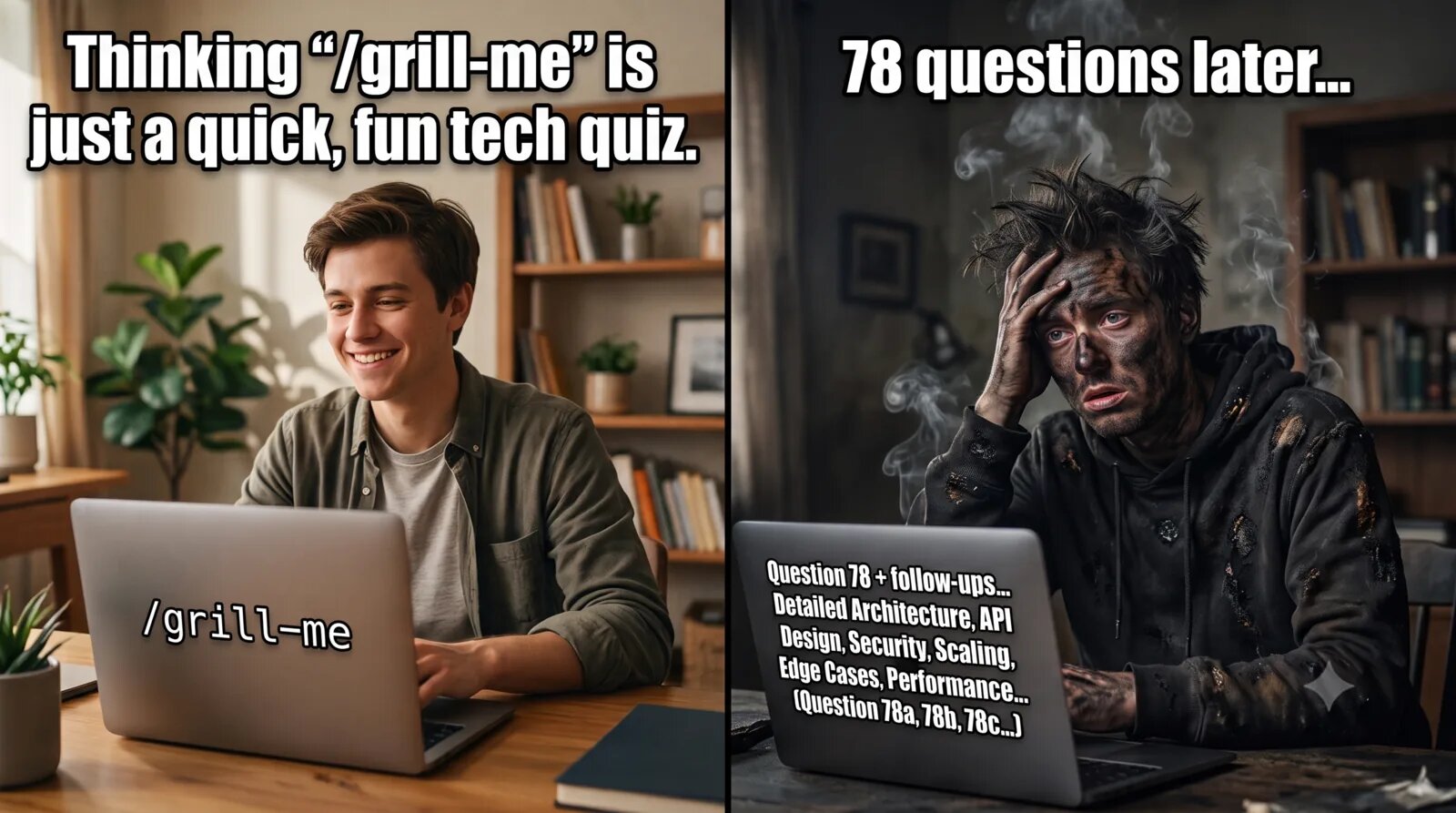
When to Stop Planning With an AI and Start Building
A few days ago I sat down to plan a small build with an AI agent. I fired up a
skill called grill-me, Matt Pocock’s (on GitHub here),
that interviews you relentlessly about a plan before you touch any code. It walks
your decision tree branch by branch, asks every question whose prerequisites are
already settled, gives you a recommended answer for each, and will not declare
the session done until the whole tree has been visited. The idea is sound:
surface the assumptions you would otherwise carry in silence, decide the things
that matter up front, and only then build.
4 hours and 78 questions plus the follow-ups later, I had a plan. A good plan, honestly. Sharper than the one I walked in with. And not a line of code had been written yet.
I want to talk about that gap, because it is the whole game.
The axe
There is an old line, usually attributed to Abraham Lincoln (though it appears nowhere in his collected works and surfaces in print only decades after his death): “Give me 6 hours to chop down a tree and I will spend the first 4 sharpening the axe.” The sentiment is real and it survives for a reason. Preparation compounds. A dull axe makes the chopping take all day; 1 hour on the grindstone and the tree falls in the remaining time. I believe this. The grilling produced a better artifact than I would have produced alone, and I will say that plainly: when it works, it works.
Here is the catch. Nobody in that proverb ever checks whether the thing they are about to chop is even a tree. The quote assumes the task is known and bounded: 1 tree, 6 hours, done. Real builds are not that. Real builds are a fog you walk into, where half the requirements evaporate the moment you touch the material and the other half were never requirements at all. And a grilling session, by design, forces you to answer questions about every branch of a tree you have not grown yet.
That is waterfall with a chatbot.
What 4 hours of planning actually buys you
To be fair to the session, it earned its keep in places. It caught a decision I had been quietly postponing that would have forked the whole design 2 days in. It made me state my assumptions out loud, which is the cheapest bug-finding technique there is. I am not telling you grilling is bad. I am telling you it has a failure mode, and the failure mode is invisible while you are inside it.
The failure mode is that planning feels like work. You are typing. You are thinking. The agent is engaging with your ideas, pushing back, making you sharper. 4 hours go by and you feel like you have had a productive day. You have not. You have produced a document about a thing that does not exist. Every question you answered about the caching strategy, the auth model, the retry semantics, those were answers about a system with no endpoints, no database, no users, no real constraint pushing back. You were imagining problems. Some of them will turn out to be real. Most of them will turn out to be problems you do not have, because the shape of the actual problem only becomes visible once enough of the thing has been built to bump into it.
I used to be the person who did this on purpose. I would open a fresh chat, describe the app I wanted, and let the agent and me riff for hours on architecture. It felt tremendous. I was “doing AI-assisted engineering.” What I was actually doing was procrastinating in a way that felt like the opposite of procrastinating, which is the most dangerous kind.
Then there is the convergence problem. Any planning framework that calls itself done when every question is answered has a blind spot: it assumes the questions are finite. In practice they are not. Every answer you give spawns more questions, each more granular than the last, and nothing in the framework tells it to stop. Some setups close the loop on their own. Most do not. You end up answering questions about the question about the question, and the only thing that ends it is you deciding it has ended.
The thing that actually matters: knowing when to stop
Here is where experience and inexperience diverge sharply, and I do not think there is a shortcut across the gap. But there is a way through it.
If you have built a few of these things, you already know where to stop. You know which decisions are load-bearing and which are bikeshedding. You know that you do not need to pick a caching layer before a single endpoint exists that might need caching. And you have a skill that is harder than it sounds: you can tell the agent, mid-round, “no, we are not deciding that now, that is a wall I will hit on my own time,” and the agent will fold it back into the tree and move on. You can yell at it, in other words. That ability, to refuse a question, is the real skill, and you only have it because you have already hit the walls the planning was trying to spare you. The grilling is most useful to the person who needs it least.
If you are earlier in the journey, my honest advice is not to take my word for any of this. Take a small task, something you could finish in an afternoon, and do it 3 different ways:
- A one-shot prompt: describe the goal, let the agent build, accept the mess.
- An unbounded grilling session: answer every question it asks, for as long as it asks.
- Something in between.
Then sit with all 3 results and feel the difference in your hands. Which one taught you more? Which one shipped something? Which one felt like work and produced nothing? That contrast is the only thing that will calibrate your own sense of when planning has crossed the line into procrastination. Nobody can hand you that sense. You build it by touching the stove.
The rule I landed on
After a lot of these sessions, the number I trust is 20 to 60 minutes of planning, scaled to the size of the task. That is it. For a greenfield app, a whole new thing, I still will not blow past 1 hour of upfront planning, and I know how that sounds. It sounds reckless. It is not. It is an admission that most of what I would “need” to decide in hour 3 is actually decided better by the first real wall I hit in hour 2 of building. The uncertainties do not queue up politely for the grilling; they introduce themselves on contact with the material. Planning for them in advance is planning against a phantom.
The pattern that actually works for me is short sprints. Plan a thin slice, 20 minutes of grilling, just enough to agree on the next executable step. Build it. Hit whatever wall the building exposes. Come back and grill again, but now the questions are grounded in something real instead of imagined, and a grounded question gets a vastly better answer. Repeat in roughly 1-hour loops. The grilling gets sharper every cycle, because each cycle feeds it facts that no amount of upfront imagination could have produced. The tree gets visited, but it gets visited in the order the real system dictates, not the order a model guessed at.
Swing
Sharpen the axe. Absolutely. The first 4 hours are well spent when the task is real and known. But you cannot fell a tree by sharpening forever, and a planning session that never terminates is not thoroughness. It is avoidance wearing thoroughness’s coat. At some point you have to stop answering questions and put the blade in the wood. The grilling is for finding the tree and getting the axe ready. The chopping is still on you, and it starts the moment you stop answering questions and hand the plan to an agent to build.